Why “Kettensprenger” is not a “pro-home office book” but a leadership book.
By Georg Blum (from a leadership, CRM, and transformation perspective)
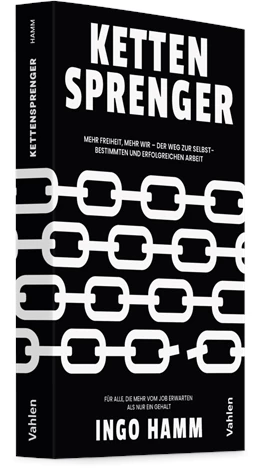
At first glance, “Kettensprenger” by Prof. Dr. Ingo Hamm appears to be yet another book on the home office debate.
However, upon closer reading, it quickly becomes apparent that the location of work is only the hook here—the real topic is leadership. Leadership in the context of freedom, responsibility, effectiveness, and community.
Hamm succeeds in exposing the heated home vs. office debate as a proxy war for unresolved leadership issues.
The decisive factor is not where work is done, but how work is organized, experienced, and managed.
This perspective is very much in line with modern leadership approaches, which no longer see leadership as control, but as the creation of framework conditions for value creation.
Freedom is not a privilege, but a leadership task.
From a leadership perspective, Hamm’s reassessment of freedom is particularly convincing. For him, freedom does not mean arbitrariness, but rather the ability of people to take responsibility—for results, for cooperation, and for the common goal.
In doing so, he deliberately leaves the comfort zone of classic management logic. Freedom is not distributed, but enabled. And this is precisely where the leadership mandate lies.
Leadership does not mean controlling people, but rather creating conditions under which they can be effective.
This attitude runs consistently throughout the book – from the five types of motivation to the “golden mean” of hybrid work, in which focused individual work and social interaction are deliberately balanced. For leadership practitioners, this is not an academic game, but an invitation to differentiate rather than “one size fits all.”
Leadership beats location – empirically and practically.
The book is particularly strong where Hamm combines research and leadership practice. The much-cited study by Manchester Police clearly shows that productivity gains do not come from working from home, but from good leadership. Only when managers consciously distribute tasks, can “read” people, and hit the sweet spot between over- and under-challenging them do the effects double.
What am I still missing? Technical support that managers can take advantage of. There are about 550 to 600 project management and collaboration tools in the MarTech landscape. Using them appropriately helps with organization and collaboration.
From a modern leadership perspective, this is a key insight.
Hybrid work is not an organizational model, but requires tough leadership discipline.
In doing so, Hamm contradicts both technocratic promises of AI salvation and romantic fantasies of self-organization. Leadership remains human, relational, and context-dependent. Algorithms can support, but not lead.
The “we” is not a soft skill, but a factor of productivity.
What clearly distinguishes “Kettensprenger” from many New Work books is its clear emphasis on the collective element. Hamm impressively shows that commitment does not arise from working alone, but from the shared experience of meaning, trust, and belonging.
The chapters on the “real we,” trust, presence, eye contact, and informal interaction make this clear.
Collaboration is not collateral damage of efficiency, but its prerequisite. As mentioned above, this is cleverly supported by MarTech software.
Especially for managers who lead organizations through transformation, crises, or cultural change, this is an important counterpoint to pure KPI logic.
Complementary leadership perspective: Freedom needs structure – and trust needs nurturing.
What Hamm implicitly makes very clear can be further emphasized from a leadership perspective: The biggest hurdle to hybrid work is not a lack of discipline, but the fear of losing power and control when managers no longer see the process of work being created, but “only” the result. Presence has long been a substitute indicator for leadership. If this is no longer the case, other coordinates are needed: clarity of goals, prioritization, and transparency about progress, not about attendance.
Hybrid working therefore does not come about through regulation, but through a moderated balance.
There are tasks that can be performed excellently through concentrated individual work, while others require proximity, exchange, and joint thinking. Moderating this balance and giving teams the freedom to organize themselves is not a weakness, but a mature form of agile leadership.
Hamm’s chapter on predictive maintenance of employees is particularly relevant in this context.
Leadership is not understood as intervention in a crisis, but as the proactive cultivation of energy, motivation, and effectiveness. This corresponds to the principle of “loving neglect”: managers are not permanently present, but they are reliably available. They do not constantly intervene, but they ensure that the framework conditions are right, that overload becomes visible early on, and that focus remains possible.
In my opinion, this also reveals an uncomfortable but honest point:
You retain employees who fit your own leadership style. Those who practice strict leadership will attract people who need clear guidelines. Those who lead in a goal- and results-oriented manner based on trust will win over some people – and lose others. Both approaches are legitimate. It only becomes inconsistent when results-oriented leadership is demanded, but employee presence is still to be controlled. Those who truly lead in a results-oriented manner will enable hybrid working because they know that this will achieve better results. Or not.
Critical assessment: Not a recipe book – and that’s a good thing.
Those looking for a simple model or a quick blueprint will be disappointed. “Kettensprenger” requires reflection, debate, and sometimes self-criticism. Hamm makes it clear that not every team functions equally well in a hybrid setting. Not every manager is ready for this.
This is precisely where the book’s strength lies. It does not provide ready-made recipes, but rather guidance, thought models, and decision-making logic. Leadership is not simplified, but taken seriously.
Conclusion & recommendation
“Kettensprenger” is not a “pro-home office book.” It is a leadership book for a working world that needs to rebalance freedom and responsibility.
It is a clear recommendation for managers who want to make their work not only more efficient but also more meaningful. Not because the book provides simple answers, but because it asks the right questions:
- How much freedom does responsibility require?
- How does genuine commitment arise?
- And what does leadership mean when control no longer works?
In other words, more freedom requires more leadership, not less.
This also means that there is no “one leadership method fits all”; instead, different leadership methodologies are needed depending on the team, goal, type of task, project method, and personalities involved. This may be time-consuming, but it is worth it.
PS: Hamm’s “chain breaker” fits remarkably well into my CRM Manifesto philosophy.
Since 2021, I have been advocating the dissolution of functional organizational logic in favor of value-oriented, collaborative forms of work. This is precisely where Hamm provides strong reinforcement in terms of content:
His liberal leadership approach, focused on responsibility and effectiveness, underpins the thesis that genuine collaboration does not arise in silos, but where people are allowed to work toward common goals. In this sense, “Kettensprenger” is not a counter-concept, but a psychologically sound addition to the argumentation of the CRM Manifesto.